

Why Is Digital Marketing Important To Small Business Owners?
Digital marketing helps small business owners gain exposure for their brand, generate consistent revenue online and collect data on their customers and prospects throughout the process.
Since March 2020, we’ve seen an increased demand for online media consumption as the world’s proven itself capable of working, socializing and, essentially, living online.
Digital marketing is not only useful to reach those users, but it’s a cyclical source of lead generation and data on new and returning customers.
When you start digital marketing for your small business, always start with brand awareness. Then, branch out into social proof & engagement, then bottom-of-funnel revenue generators, in that order.
As Manuel Suarez of Attention Grabbing Media puts it, you must “earn the right” to make an offer to your customers. You don’t get there by selling first and introducing yourself second.
What Is Google Analytics And Why Do I Need It?
Google Analytics is your primary source of campaign analysis when it comes to paid digital advertising. Beyond that, you can gain extremely valuable insights about your website’s organic traffic.
For example, I may want to know if my social media marketing traffic or my organic Google search traffic is converting better, so I can allocate more budget toward the better performing platform.
Valuable Google Analytics insights include things like:
- Time on site
- Most popular pages viewed
- Number of conversions (sales, lead forms submitted, etc.)
- Average order value
From a paid campaign perspective, you’ll want to use Google Analytics to set up your remarketing audiences. Use those audiences to run paid remarketing campaigns for some easy sales.
Am I an “Essential Business” in the COVID-19 Crisis?
Your real question should be, “do I fill an essential role” within your business. Below is a complete list of workers deemed “essential” by the Ohio government.
- Healthcare workers: nurses/doctors, transports at the hospitals, manufacturers of medical equipment, OBGYNs… you get the idea. Anyone that uses a touchpoint in the medical realm fills an essential role in the eyes of the Ohio government.
- Public Safety workers (firefighters, EMS, police, etc.): please come to work, we need you- and are eternally grateful for your service!
- Food & Groceries: from farms to groceries to cafeterias, you are absolutely essential.
- Utilities: those who work in energy (gas & electric), water & sanitation are essential for obvious reasons.
- Transportation: wondering why the streetcars & subways are operational? Essential businesses! Boarder beware, however, since it could be a tight space to contract disease.
- Public Works employees: maintenance, communications & IT for enforcing land & river codes are still essential during the crisis.
- Chemical & Hazardous Material workers: if you’re dealing with toxic waste (or the possibility of creating it), you are still cleared for work!
- Financial Services: traders, mortage lenders, banks & finance experts… I’m sure you’re dreading work tomorrow, but you’re on duty. Thanks for keeping us as sheltered from this crazy economy as possible!
- Defense: military personnel, including those under contract with the department of defense, will report throughout this crisis. Again, thank you all for your service.
- And a few more: elections personnel, educators (though currently working from home), U.S. Customs workers, hotels maintaining COVID-19 precautionary measures.
Hey, we’re all essential let’s not forget. If you’re experiencing cabin fever, try taking on a new hobby. Start a Tik Tok for your business or add some trending videos to your YouTube channel (and blast them over social media, of course).
Otherwise, a full list of “essential businesses” in Ohio is available at https://www.wlwt.com/article/what-are-essential-businesses-heres-what-will-remain-open-in-ohio/31878972
Does Google Ads allow same keywords of different match types in a single ad group?
Oh yeah! In fact, advertisers all over the country use it to a/b/c test their keyword to see which works best. Also, keywords in different match types do NOT cannibalize from each other but will likely perform differently due to their Ad Rank. Check out Google’s Support page to learn about similar keywords in the same ad group.
What is the best social media platform to advertise?
Facebook Ads is my favorite and I use it as a default for 3 reasons:
- Facebook Ads includes Instagram automatically
- The options for targeting are better than any other platform I’ve seen
- You can operate at all or specific parts of the buying funnel.
You can use spaces like Snapchat, Tik-tok (new), Yelp, Pinterest, etc. if one of these is particularly valuable to your business. For instance, DIY-ers SHOULD be promoting on Pinterest. Restaurants SHOULD be promoting on Yelp, but ALL can be successful in Facebook Ads.
Start with a small budget and increase as you get better working through the platform.
What Is “Rank” In Google Ads?
In Google Ads, the rank is the position you appear, relative to the very top of page 1 in the Google Search Results page.
Rank 1: First ad seen
Rank 2: second ad seen
Make sense?
In Google Ads, your “average rank” metric, as it were, can be found under either of these two column headings:
% Absolute Top Impression Share (% of time you appear in “rank 1”)
% Top Impression Share (% of time you appear in the ads at the top of the first page)
What keyword match types cost the most?
Keyword match types essentially cost the same, but it’s a little more complicated than that, so let’s revisit the buying funnel to explain.
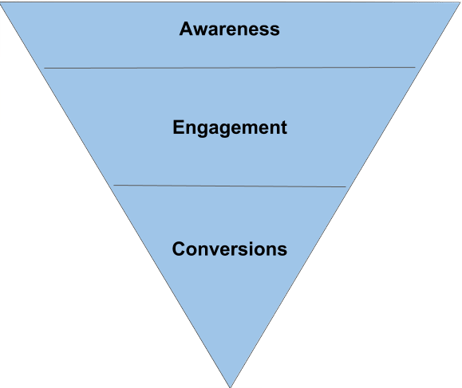
Oh yeah, I see your cogs turning from Marketing 101 class! If you picture our SEM keywords existing all throughout the “conversions” section of this funnel, you’ll notice there’s room at the top and the bottom of the funnel.
Our keyword match types allow us to create a sort of “mini-funnel” for the bottom section of our regular funnel! Broad match keywords are at the top, phrase match toward the middle, and exact match at the bottom.
As a community, we understand that as they descend through the funnel, our audience becomes more valuable, because their chances of converting increase. We also understand that exact match [order pizza] will only return search terms with those words in that order, whereas pure broad match, order pizza, could return a whole list of ugly. Therefore, exact match is more likely to convert customers, placing it lower on the buying funnel than broad match (and also broad match modified and phrase match).
Exact match keywords tend to require a higher bid because they provide audiences that are more likely to convert, and your competition creates a war to win these exact match audiences over the broad match audiences. It’s also worth a note that this issue only exists in automated bidding, since manual CPC allows you to set your own costs per click.
How does Google determine the landing page experience?
When trying to improve the landing page experience in Google Search Engine Marketing, I look at 3 things:
- Do the keywords on the landing page reflect the keywords or types I’m bidding on?
- Can I easily navigate the landing page? (Call-to-action button above the fold, text size large enough, etc.)
- Is the technical SEO in place? (Page speed, optimized images, etc.)
In other words, I essentially perform an SEO audit, pretending I’m trying to rank for my paid keywords.
Which negative keyword match types should you use?
Somehow, Google’s managed to attack our positive keywords relentlessly with new targeting crap like “oh, if they typed exact match [backpacking] then surely they’d want to show up for search terms like [backpack]!”
No Google! I do NOT want to show up for that.
Anyway, they left negative keyword match types alone where they’d modified the pants off our positive keywords. If you type into a negative keyword list [backpack] but have a positive keyword [backpacking], Google will show your ad correctly. Same thing with any other exact match keyword: if the user searches your exact match negative keyword(s) exactly, your ad won’t show up.
Phrase match is similar in that if you use phrase match negative keywords like “best backpacking spots Cincinnati,” you wouldn’t show up for something like [hey Alexa find the best backpacking spots in Cincinnati] but you would show up for [backpacking]. Make sense? All your phrase match keywords must be included in the user’s search term in the order that matches your negative keywords for your ad to be disabled.
I’m about 95% sure the Google employees went on break for their description of negative broad match keywords in their About Negative Keywords section. They must’ve trained a monkey to type this out, or maybe they just have no clue what goes into searches for pure broad match keywords either, but either way: the literature says that if you type out pure broad keyword, flowers, your ad will be eligible to show on [red flower] but not on [red flowers]. Do with that what you will.
For me, I usually stick to phrase match. When I don’t, I use broad match modified. That way, you’re still fulfilling the need to exclude more than one word, but those words don’t necessarily have to be in a certain order in the user’s search term.
I’d say about 90% of my negative keywords are phrase matches, made up of random words or competitor keywords. That’ll get you through most dangerous waters when it comes to refining searches.
Does SEO and SEM go together?
Nah, unfortunately not. Not in the sense that your guy and your SEM guy are the same person, at least. Usually your run-of-the-mill freelancer or agency worker will specialize in one or the other.
If you want quality representation on Search Engines, I’d say they go together to achieve that. Imagine being able to show up right at the top of the Google Search Engine Results Page with your advertisement, and then also show up on page 1 with your organic listing (which you don’t pay for). That’s a great example of SEO and SEM going together very well.
So what’s the difference? SEO is search engine optimization, and SEM is search engine marketing. These are very similar sounding acronyms, but when it comes to SEM vs SEO, it’s very different types of work associated with them.
The most attractive thing about SEO is that it’s free if you do it yourself. It can be dull work, learning coding and the technical rules for it, but if you play the long game you could have great traffic results!
The most attractive thing about SEM is it’s fast, and if you’re willing to put up a fat bid, it’s instantaneous. I don’t recommend it, because I believe firmly that SEM is the long game too, but SEM will get you results in about three months, where you might be working on SEO for many months, or even years before it catches on.
What is PPC?
In the digital marketing world, PPC is “pay-per-click” advertising, which is how most of our campaigns are run. This throws a major wrench in the works for old-school advertisers, who sell things like billboards and TV spots on impressions only, but we find a lot more success (and, in most cases, even more impressions) if we pay only when our audience clicks on our ad.
When someone says they run PPC campaigns, they’re telling you that, across whichever channel- Google, Bing, Facebook, etc., they run advertisements where they pay money each time a user clicks on their digital ad.
PPC advertising is the widely used older brother of largely outdated print techniques.
What does a digital marketer do?
Interesting question with a ton of answers!
I may be way out of line here, but a professional of digital marketing should be able to design, implement and report on a digital campaign of some kind for your business. These campaigns include Facebook & Instagram ads, Google Ads, Amazon ads, Pinterest ads, etc.
A digital marketer is the key to growing a business’s online presence. That person should be able to look at what you’re doing online, make a plan, and generate more traffic and qualified traffic from day one
How do you market for a construction business?
Construction, like other service-based businesses, is largely based on generating high-quality leads, so your best bet is a combination of creating free, educational content on your website and bidding high on lower-funnel audiences.
Your audience needs to see your company as geniuses in the field of construction, and should recognize your website each time they take a step forward in the buying process.
Create a 3-D representation of what they’re buying, walk them through the process of contractors behind-the-scenes, and above all, be at the top of the Google Search results when their credit card is out.
For your marketing budget, 30% should go toward creating valuable content driving traffic to your website (project cost calculators, color-changing simulators, etc.), 30% toward middle & top-of-funnel tactics (social media, billboards, display marketing, etc.) and 40% should go toward bottom-of-funnel tactics (search engine marketing and remarketing).


