
We’re all fighting for that top spot in Google. We’re all looking for the diamond in the rough when it comes to industry keywords, and we have ALL been let down when our incredible keywords have yielded a big, fat zero in the results column.
With the emerging culture of smart speakers, however, we can achieve quality results simply by reacting to the current state of voice search.
To throw some statistics & trends at this issue, 55% of teens use voice search daily, and by 2020, consumer spending via voice assistants is expected to reach a whopping 18%! The numbers are growing, and those who reading the signs know it’s time to study up on this new tactic.
Luckily, there are three key differences of which we can be aware. Voice search has long-tail keywords (more than 3-5), uses natural vocal language, and tends to search for things within driving distance.
One other consideration not commonly thought of is the social consequences of each voice search. If you’re out with friends, you want to talk to the phone like you would others, and using sentences packed with keywords just comes off as robotic. We’ve all made fun of that one friend who enunciates differently when talking to their phone, sometimes learning for the first time that they knew how to use certain words in a sentence.
Think about your audience: how much easier is it to backspace and type out a new search, rather than completely “respeak” incorrect words with your voice? Here is an example from a campaign of mine where my audience used voice search:
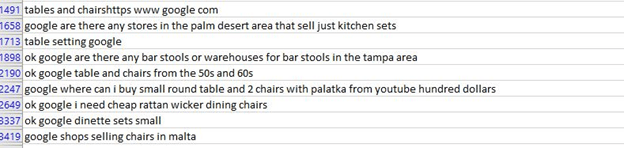
Marketing extraordinaire though you may be, I’m guessing that specific search didn’t come to the top of mind when building out your PPC campaign or SEO keywords for your website. It would be very tough to predict “keywords” the size of a sentence. That’s why I choose another option.
If you break down that search, you get a few different keyword groups like “small, round table” and “palatka,” and maybe even “hundred dollars.” I’d reference those keywords, then I’d be sure to focus on the intent behind the search.
The user didn’t search “how,” they searched “where.” Therefore, in my landing page, I know I’ll need to answer with my location, or the location of an affiliate party that sells this small, round table & chairs. This is a common voice search strategy used by brands globally.
This is very different from text search, because the text version of this would likely have omitted that intent as well as some other words, leaving something like “small round table and 2 chairs with palatka.”
Voice & conversational search is something that even Google is still catching up to, but in a lot of ways SEO experts are not. Professional bloggers are extremely conversational in their tone and sentence structure and can easily relate to these voice searches.
“Were a blogger to take on a voice they might in an otherwise more professional setting, there may be complications to trust-building, the likes of which could prove too exclusive to constituents.”
Exaggeratory, but you get the idea. Speaking and writing are becoming one, and we must get out in front of those consumers, regardless of which they prefer to search with. It may be worth hiring a writer for voice search to keep things light and conversational, while keeping a professional edge and integrity to your brand in your website copy.
For my part, I try to read my long-tailed keywords in PPC campaigns aloud in the office, just to see if I’d look ridiculous doing it as a consumer (my cube-mate is now up to speed, and I’ve started get back a “yes” or “no” over the dividing wall each time).
This simple tactic has vastly increased my ability to predict what others will search for with voice and has led to an absurd amount of impression share on long-tailed keywords with incredibly high search volume, relative to other, more predictable long-tailed text keywords.
Some look at it as another difficult marketing technology to learn, but I look at voice search optimization as an exceptionally good targeting tool. If my product can stand in the free market and we’re accurate with our messaging, we’ll be searched for on a very granular level, which will only serve to decrease costs and increase value of customers.
Resources:
- https://www.bluecorona.com/blog/voice-search-digital-marketing-strategies
- https://www.aithority.com/guest-authors/state-of-voice-search-2019/
- https://quoracreative.com/article/voice-search-statistics-trends
- https://www.morevisibility.com/blogs/sem/differences-between-voice-search-and-text-search.html
- https://digitalmarketinginstitute.com/en-us/blog/voice-search-why-your-brand-needs-a-voice-strategy
- https://lifehacker.com/two-ways-to-respeak-incorrect-words-in-google-voice-s-1711732521
- https://www.searchenginejournal.com/voice-conversational-search-overcoming-challenges/230035/#close
- https://searchengineland.com/how-much-should-we-care-about-voice-search-it-depends-on-our-target-audience-318752


