

What Does A Brand Awareness Campaign Do?
Brand awareness campaigns get a bad reputation, mostly because Search Engine Marketing (SEM) and remarketing bring in the trackable revenue.
But brand awareness campaigns work in mysterious ways! Imagine this situation:
Your favorite music station plays all day while you’re at work as an investment portfolio manager. You hear an ad two or three times for a great product, but you don’t really hear the words.
Your research on different investments’ quarterly numbers take you all over the internet, where you see ads that seem familiar for some reason. The product you heard on the radio earlier definitely started with the same letter, “R.”
You wander over to Facebook on your lunch break and see that same familiar name pop up – something almost medieval-sounding, only this time it’s a video. You watch for a few seconds and quickly move on. Your attention span only lasts so long.
Later in the day, a customer meeting goes well, but they ask for some leniency with their assets to work on their own investment management skills. You tell them you’ll keep an eye out with something user-friendly and reliable.
Your first search for “reliable, user-friendly personal stock trading” leads you to a native article featuring the same green logo you’ve seen and heard about all morning: “Robinhood.”
You send the link via a mass email to your customers looking to self-manage a portion of their investments.
Now look at the lifetime value here. How much money did the investment company, Robinhood, just make from display ads alone?
This is advertising in its most basic sense. You target an audience, you hit them across multiple touchpoints while they’re high in the funnel, and eventually they become familiar enough with your brand to engage.
In this case, the portfolio manager didn’t even need to convert. He just became a Robinhood brand ambassador for his clients, who together wield hundreds of millions of dollars to spend with the app.
This is an example of why brand awareness works.
Which Platform Should I Use For Brand Awareness?
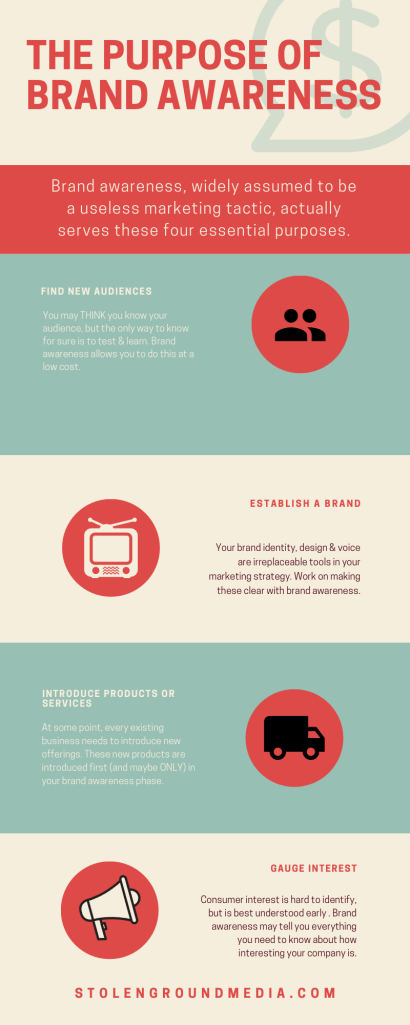
Brand awareness should be the first thing you work on as a growing business, and the key is to spend as little money per click as possible on quality audiences.
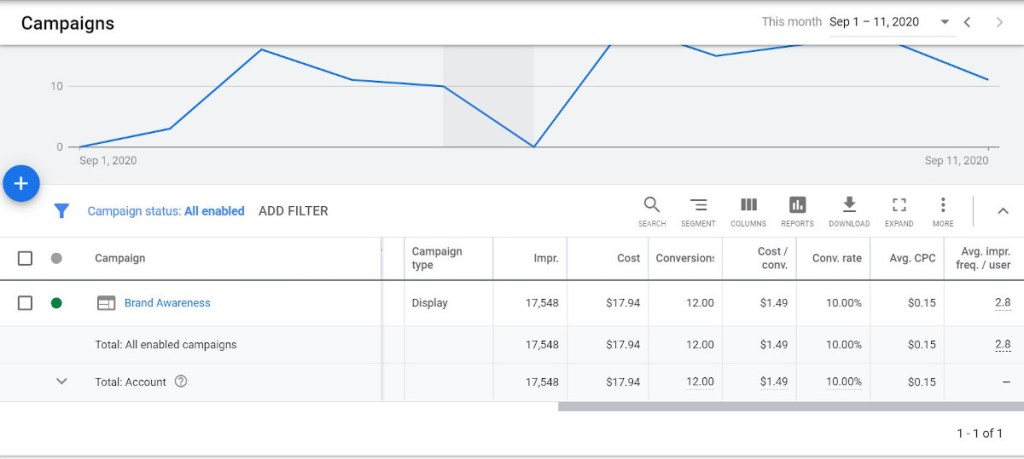
I lead clients toward the Google Display Network (or GDN, for short) to achieve this for their brand awareness efforts. Set a maximum CPC of $0.50 and test different audiences (and don’t use keywords at first).
With a maximum CPC of $0.50 set on my campaigns for Stolen Ground Media, I maintain an average CPC of only $0.15.
The other great thing about Google Display is that you can show in so many different placements. While this does require that you upload a number of display image sizes, you can create many of these images in free apps on your phone like Canva or PicMonkey (PicMonkey is a paid platform after your free trial is up!).
You can also use this excel spreadsheet to check off your image sizes as you obtain them, AND it shows you which image sizes are most effective, according to Google!
Some people use Facebook Ads to great effectiveness for display advertising. I do recommend it if you’re already familiar with the platform, but if you haven’t used it before, there is no benefit to learning that platform over Google Ads.
Plus, it’s only effective for audiences who actually have and use social media, and you must be militant about keeping your cost per click down. Otherwise, you could end up paying up to 5x as much as Google Display for brand awareness traffic.
You could use broadcast advertising (TV & radio), but you won’t be able to track their results like you can in digital advertising. This leads to an incomplete story about what was effective in your strategy.
Finally (and I can’t believe I’m saying it), you could use traditional marketing. Billboards, magazines, newspaper ads are all brand awareness plays. Not to come off biased but use these only if you’re advertising geographically to audiences where internet doesn’t exist.
The Return On Ad Spend Of Brand Awareness Tactics
Brand awareness yields a massive return on ad spend for companies. The problem is that the return is not an immediate financial one. You’re not investing in brand awareness. You’re purchasing it.
Even though it’s a digital strategy where results are measured, you’ll find that the KPIs (key performance indicators – or the “what-the-heck-do-we-actually-care-about”s) are not sales & leads.
Instead, your money went toward purchasing an open door. You doused your cold audience in warm sunlight.
Get used to the idea that you may never see the financial return on your brand awareness campaign, but that business will just be better as you stick with it in the long-term. Patience is the key to being successful in brand awareness.
The other benefit is that it’s fuel for the rest of your strategy.
Engagement can’t happen with a cold audience and your sales & leads can’t happen without engagement.
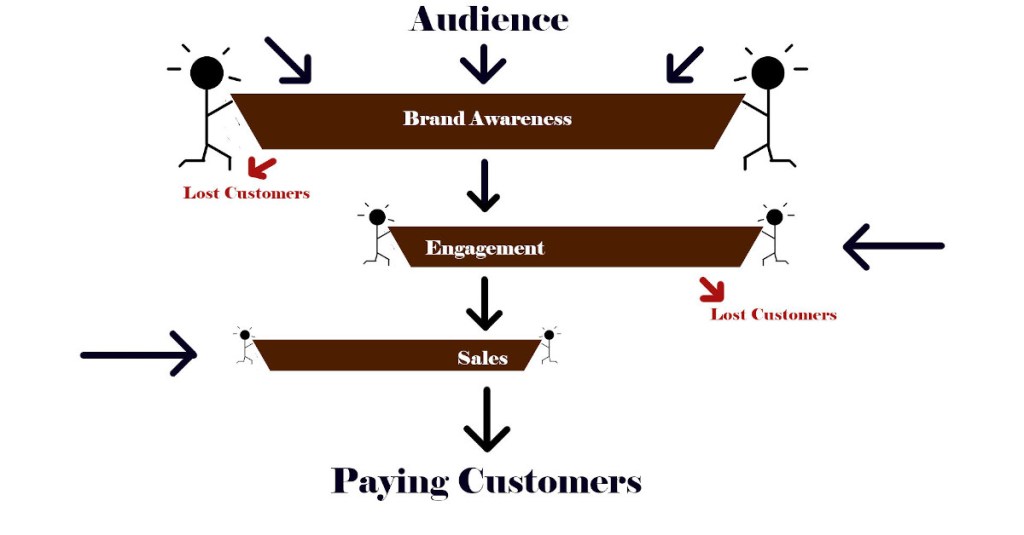
To remove a brand awareness campaign due to lack of “return on ad spend” is a giant, foolish trap that eats bad businessowners for breakfast.
How Long Should A Brand Awareness Campaign Last?
Your brand awareness lasts as long as your business advertises with digital marketing.
Now I’m not a shady marketing “guru” who pulls you onto a blog post only to say “you have to spend a million a month and never stop,” so I’ll qualify this statement: you must run brand awareness, but you do not always need to run middle and bottom-of-funnel techniques.
If you need to cut costs, cut out SEM, Remarketing, Facebook Ads & any other middle or lower funnel strategies first.
Now, the good news.
Brand awareness is not expensive. Or, at least, it doesn’t have to be expensive. Your campaigns get clicks for pennies, so if you only have a dollar a day to spend, that’s all you need!
Now, do NOT spend $30/day for two weeks, then $4.08 for the next month, then $150 for a holiday weekend, then back down to $1/day… you get the idea.
Aside from this affecting automated bid strategies in a very negative way, your audiences themselves simply can’t get any consistency from your brand.
An audience member might see you three times in one week, then not see you again for a month. Then see you fifteen times in a single day, then not again for a few days.
Every day your display audience sees an ad is a step forward; every day they don’t see an ad is two steps backward.
Get your campaigns on a consistent schedule and commit the money in advance for no less than a six-month period. If you’re using a dollar per day, that means you need to save around $180 before you get started (6 months x 30 days in a month x $1 = $180).
Design In A Brand Awareness Campaign
If you’re new to branding, you need to remember one thing: consistency.
Say it over and over, say it in the mirror, sing it in the shower, form the words with your spaghetti-oh’s. Consistency in your brand will get you much further than you ever thought possible.
Did you know that McDonald’s designs their stores almost the exact same way every time? They use the same colors, the same bags. The employees are even required to say “my pleasure” after every order to elicit a pattern in their audience, which leads to habit.
When you stay consistent, your brand goes from being an advertisement to being a friend. An audience is comforted by your brand being on the website they’re browsing instead of defensive about being sold to.
That doesn’t mean you make a single ad and force it on users in the same place on the page every time. If you reviewed the checklist for your Google Ads display sizes attached earlier, you know that your ad can show all over a single webpage.
As your audience browses online, they’ll see your brand in different positions, leading to the feeling of different touchpoints.
Configure your display ads so that they’re different sizes, but still use the same brand colors, brand font, logo and call-to-action.
The easiest way to do this is to create a single ad exactly the way you want it, and then copy & paste the elements of that ad over to different sizes.
See? Creating display ads isn’t that hard after all! This is exactly the way I created mine!
As you key in on branding & identity in your social media & remarketing and when you add new content to your website, keep these same design themes in mind.
Of course, you’ll feel the urge to change these within the first few weeks of launching the brand colors but stick with the method. Your customers will be left confused and without guidance if they think you’re a different company because you added the wrong design element to your ad.
How Much Do Brand Awareness Image Assets Cost?
Hiring a graphic designer for your brand awareness images is not exactly cheap. If you find one that knows what she’s doing, you may be looking at anywhere from $200-$600 for all of your sizes.
That’s why it’s so important to repurpose your ads.
While Google will not run your ads at all if they’re the wrong size, Facebook will auto-crop them to fit their specs. Reuse them for your social media ads and as complements to your regular posting!
Try sampling a display ad as your Facebook cover photo, or post one of them to your story, with a few quick edits, of course. You could also use your display ads for your website design.
Find out what people think of your ads and be responsive enough to change them if you find out they’re not driving quality audiences.
Ask your social media followers what they think of your ads. Do they like them? Do they hate them? If you can’t get a warm, Instagram audience excited with your ads, then your cold, brand-awareness audience certainly won’t care.
I’d also like to recommend again the use of free display ad creator tools and the use of templates. These will cut way down on your total time spent working on these, allowing you to focus on the launch of the campaign.
You’ll also be able to easily control tiny changes in your ad designs, messaging & format. You’ll likely see a thousand things you want to change by the end of the first week and you need a quick response plan.
You don’t want to be two weeks behind on your campaigns because you and your Google Display Ads designer were going back and forth about file sizes and aspect ratios.
Brand awareness may be top-of-funnel and have a reputation as a bad investment financially, but we as an industry are getting more and more agile about finding out the customer journey to conversion.
That transparency is going to put some businessowners’ heads between their knees breathing into a paper bag, knowing full-well they just slashed the display budget for an SEM push.
Get out in front of this tactic and make being known a priority. Your bottom-of-funnel techniques will thank you later.
Resources:
What Is Ambassador Marketing? [The Complete Guide for 2024]
https://smallbusiness.chron.com/advantage-using-tv-radio-media-advertising-17673.html
https://www.adherecreative.com/blog/patience-the-missing-key-to-brand-awareness-roi


